

Ash
إداري سابق
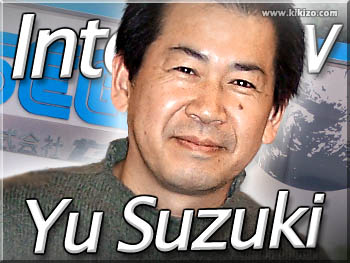
Kikizo: Suzuki-san, thanks for your time today. Can you tell us about your new arcade game, Psy-Phi - what is the setting and the story of the game, who are the characters?
Yu Suzuki: It's an action-shooting game with 1-on-1 combat, and it's the first game of its type to use a touch panel control. Everything in the game is controlled through the touch screen, so the control is more directly connected with your thoughts and physical actions.
All the characters in the game have psychic capabilities... they're not robots, they're all humans [capable of] extrasensory perception, if you will. The costume designs for the characters look very futuristic. Some characters are even a bit... sexy [laughs]. They're not like characters I've used in previous games I've done. It's been a challenge for me to develop them
Kikizo: When did you first conceptualise Psy-Phi?
YS: A long time ago - I've had an interest in fantasy and sci-fi stuff since my childhood, when I was watching a lot of anime.
Kikizo: You mean stuff like Mobile Suit Gundam?
YS: A bit older than that. In particular, there was an anime and manga series called Babel II that really gave me a strong interest in that sort of thing.
Kikizo: How long has it been in development?
YS: Planning on the game began about 2 years ago [around the time Mr Suzuki's 'Digital Rex' studio was first announced].
Kikizo: Why did you choose this touch screen input method over a more traditional control style? How is it used in gameplay, specifically?
YS: I thought the standard joystick and button layout was getting rather boring. As I mentioned before, I think you have more direct control of the characters through the touch screen. It's been a challenge to implement, but as any good developer will tell you, it's important to try new things.
Kikizo: Obviously, there's only one console out there that has touch-screen capabilities... so do you think we'll be seeing anything Psy-Phi related on the Nintendo DS?
YS: Well, you can call Psy-Phi the Sega DS! [laughs] Actually, we've joked around about it, but... we haven't considered anything seriously. I don't think the DS is capable enough. We could make a DS [port of the] game, but I think it would lose a lot in the transition.
Kikizo: You've always liked to experiment with new gameplay. While some complained about Shenmue's QTE gameplay feature, they've been proven wrong by its popularity these days in games like God of War and Resident Evil 4. Do you strive to create something new for the sake innovation?
YS: There is always a goal set in my mind when I start designing a game. In order to achieve a new concept, I first have to devise a new gameplay system. The QTE system emerged from a need to present the in-game action scenes in a cinematic fashion. I wanted to make the action a little bit easier than, say, Virtua Fighter. As you know, timing is very critical in VF. Shenmue is rather the opposite: it gives the player a bit of extra time to think and react. Even though it's a "Quick Timer Event," it's not really quick [laughs]. It's easy for the player to understand and to make choices. You can use any sort of timing you want.
Kikizo: With that in mind, what are your thoughts on the Nintendo Revolution controller? Do you think you'd like to make a game that would take advantage of the system's unique capabilities?
YS: I quite like it. I think the gameplay experience consists of three different parts: the input device, the gameplay, and the output device. The input is, of course, the means of control. There's a lot of interesting means of input, like the recent EyeToy. The gameplay is how the game program itself responds to and uses the input. The output, then, is the feedback - audio, visual and so on - and the primary output device is always a monitor of some sort. The Revolution's focus is, obviously, the input. It's a new means of controlling the games, and I think it's an important new development.
Kikizo: We have not seen anything from you on console in a long time. Can you give us your thoughts on the next-gen consoles, and the new portable systems, DS and PSP?
YS: They're both nice, and very attractive. It's a pity Sega didn't make them! [laughs]. The DS is an interesting device, and it's mostly focused on games for a younger audience. That's very good. The PSP looks more sleek and stylish, it has a high-quality display, and its audience is older. That's good too. It's just too bad there aren't any games for it! From personal experience, I can say that my kids love the DS. I keep losing to them when we play Puyo Puyo!
As for the consoles, Sony's big point is performance. The CPU, the GPU, the hardware architecture... Microsoft is about usability, like that of a PC. Nintendo is focusing on innovation - the new input device, like we talked about before. I think it's good for the player, since it gives them a lot of options. It wouldn't be interesting if all of the console manufacturers were headed in the same direction.
Kikizo: What are your thoughts on the current arcade market?
YS: The arcade market is declining a bit. A few big companies like Capcom have scaled down development considerably. As a result, we're the strongest in the business now. That's certainly good for Sega. So even though the overall market is shrinking, we're still making a killing. We've got a sixty per cent market share in Japan now, so it's not bad at all for us. Even though the overall market is shrinking, we don't have any real enemies. That's not so bad, is it? [laughs]. Since it is shrinking, though, we've really got to focus on bringing new things to market. No more rapid-fire series of 2 or 3...
Kikizo: There seems to be a trend of nostalgia in the industry at the moment. Two of your most popular games, After Burner and OutRun are popular again and older titles like Space Harrier and Virtua Racing have been re-released. Some say that the increased popularity of old-fashioned games is because modern games have become too complicated. What are your thoughts on this?
YS: It's a matter of personal preference. Some people find tough games to be exciting. Some people like easy games. There have to be both in the market, so that there's something for everyone. Personally, I'd like to have more easy-to-play games.
Kikizo: The arcade business in the west has been in constant decline. What part can game developers play when it comes to reversing the slump?
YS: We - or another company, perhaps - need to succeed in introducing new concepts. After that has been accomplished, other people can hop on the bandwagon, so to speak. Let's think of arcade machine investments as something like a piggy bank. The operators are able to count a machine's earnings, so they can easily see if bank A is earning more than bank B. Smaller arcades operate much like this.
In Japan, Sega's arcade management operations started with smaller arcades, then moved up to Sega Worlds in various cities and suburbs, and finally culminated in Tokyo Joypolis. So, I think we also need to move towards the concept of large, more general entertainment centers, with live entertainment and food and such... like Joypolis here in Japan and Gameworks in the US. Kind of like an entertainment shopping mall or supermarket, you know? It should be an unusual, special place in people's minds
There are a lot of emerging markets where it's easy to expand. You need a disposable income to enjoy games. Korea, Taiwan, China, and India are emerging markets for our arcade games, but the disposable income isn't so high yet. We are especially busy with the market in China, in particular. As entertainment, arcade games won't vanish. But we'll have more options.
Kikizo: Not too long ago, arcade hardware was much more advanced than home console systems. Today, they are almost equal. To what extent are console games a threat to arcades, and what can arcades offer a player that home games can't?
YS: Yes, definitely [a threat]. But one thing that console games can't do is to gather a large group of spectators to watch you play. They also don't provide any large, specialized cabinets. Even if a console game does provide specialized controls, they're usually too expensive for the average consumer. But what I really think the continuing popularity of arcades will hinge on is "live entertainment" and real human relationships. Currently this is a weak point for most arcades.
Kikizo: What can Japanese developers do to combat the shrinking Japanese videogame market?
YS: I think Western makers are more likely to try new things, and are more aggressive. The Japanese companies are more conservative, and they rely too much on "safety" series, and sequels. They don't challenge themselves and the industry with new ideas. You can't make a new market out of that. People overseas seem to put more passion into making games that they want to, rather than games that will strictly sell. That is a big risk, but as the saying goes, no risk, no return. If you're in a desert, alone, you have to keep moving to look for water, you can't just sit there and wait to be rescued! Right now, we're going into the Chinese market. Maybe we'll be stronger there.
Kikizo: How do you think the rising cost of videogame development will affect Sega as a company and the videogame industry as a whole?
YS: Cost performance is a very important thing for a developer to keep in mind. You need good tools to help develop the games while keeping the cost down. Kind of like a "weapon," or something. We'll probably be doing a lot more outsourcing as well.
Kikizo: How is Sega different these days from the time when you started working here? Are you happy with how things have progressed? Do you miss the past, or are you more focused on the future?
YS: Yes, things are very different now! I do long for the past sometimes, but right now, I have TONS of stuff I need to do. I can't waste time on reflection. I'm focusing on the future, not the past. So I'd say that right now, my thought process is ninety per cent future and ten per cent past!
Kikizo: Let's talk about Shenmue. Can you tell us anything about Shenmue Online - where will the story of the game proceed from where it left off in Shenmue 2? How will Shenmue Online fit into the core series?
YS: Shenmue Online is still in development. I'm working hard on it - real busy! It's an MMO game for PCs. The original Shenmue had combat, so I'm hoping to focus more on the battle scenes. We also had a lot of events and minigames, which will carry over to Shenmue Online.
Remember how some of my old arcade games were in the previous Shenmue games? They'll be here, too. The player will be able to follow the Shenmue story through the game. It's not based on any existing Shenmue title. There are a lot of features in Shenmue that carry over well into an MMO game.
MMOs have a community aspect, with guilds, fighting, trading, etc. Shenmue has a lot of these features already. The area to explore is also much bigger than previous games. Like in the original game, you can learn many fighting techniques while you play.
Kikizo: In the event Shenmue was never finished, would the possibility exist for the story to be finished trough other media, like DVD or books?
YS: No, the story will be finished through games. The MMO will be a game that will have a long lifespan through upgrades and updates. This will allow gradual continuation to the story. It follows up directly to the story of Shenmue 2 at first, but maybe we'll move on even further as time passes.
Kikizo: As for your own work, which projects are your personal favourites?
YS: That's hard to say. Shenmue will be a project that I feel very close to. It's not just a memory; it exists as a part of me. Ferrari 355 is another one that I really enjoyed. I went to Italy, met the Ferrari guys, drove around in Ferarri's circuit, and ate at a famous restaurant - it was great!
Kikizo: Actually several Sega staff have Ferraris and you especially are clearly fond of them. What is it about Ferraris you enjoy so much, and why are they so popular at Sega?
YS: Yeah, I wonder... I have no idea what those guys think, but Nagoshi, as a former designer, probably likes the design aspect. I know Nagoshi has bought a Ferrari, but I have yet to see him drive it! Naka is a big race fan, so he is more of a fan of the technical side of the cars. Actually, uh... I really prefer bikes. Ferarri is the car most like a bike, I think. It's a 4-wheeled motorcycle!
Kikizo: Virtua Fighter and F355 are pretty realistic simulations, is realism one of the main goals in your games?
YS: Reality is not really a goal of mine, no. Reality in the context of games is nonsense. If it's completely realistic, then what's the point? What's so entertaining about the usual and the mundane bits of life? What is more important is believability within the game itself. After all, being completely unusual isn't good, either. You need a fine balance, somewhere in the middle. But I like fantasy, too.
Kikizo: Do you still play games regularly at all? What are your preferred titles and genres?
YS: No, not regularly. I actually don't play games very much, and haven't done so for quite a while. I really just play easy games with my kids. I think my gaming life these days consists entirely of air hockey, Whac-a-mole, and Puyo Puyo. Those are my three big titles! [laughs] I do all kinds of genres - fighting, driving, shooting - and I don't prefer any one in particular...Well, okay, I don't like scary games. That's about it!
Kikizo: Is there a special game you would like to have developed?
YS: Hmm, I don't really have that feeling. Well actually, there is a Harry Potter game that involves the characters playing a 5-on-5 dodgeball-like game while riding brooms in the air. I had a concept for it for a while, but then Harry Potter came along and stole it from right under me! [laughs]
Kikizo: What sort of direction do you see gaming in general headed towards in the future?
YS: I have no idea... I think that perhaps control interfaces will become more direct, with no hardware. Maybe eventually you will be able to control games with your brain waves, and chips in your body. Some of these are already used to mark dolphins and such. Some children born with weak hearts have a sensor implanted in them. In the future, you might not even need any passports! Back when I was born, I couldn't even imagine the sort of things we have today. Now we have all kinds of technology. I couldn't believe that this sort of world could exist. One of the greatest frustrations in making games is the desire of wanting to do something, but we aren't able to do it due to technical limitations. Right now, what you need to do well in games is judgement in skill, but in the future, it will probably just rely upon judgement.
Kikizo: Could you share with us a unique or weird experience encountered during your career?
YS: There have been so, so many. Well, here's one: When we were doing Virtua Fighter, I went to a Chinese Kenpo temple to do research. There was a grand master there. The first thing we did was drink. It's a white liquor, a local speciality. The Chinese custom is that you must drink 3 shots in a row for all the people that you meet. There were eight people there. Three times eight is 24. That's quite a lot.
You show that the cup is empty by turning it upside down. You don't want to upset anyone, so you do that. The grand master was impressed, and said that all the Japanese he had met before just drank beer. You had been the only one who has drank such heavy liquor, he said! [laughs] After that, he taught me some Hakkyokuken techniques... [the art used by Akira Yuki in the game] though at this point, it was looking more like drunken fist! Since he's a grand master, he'll stop his fist before it hits you. But, since he was drunk, I wound up getting gut-punched. I went down head first, onto the hard stone floor. The scar on my head left from that was actually the second! I got one in junior high before that - in Shorinji, I had something similar happen. Except it wasn't the grand master that time, but one of his students!
Kikizo: What can we expect from Suzuki-san in the future?
YS: Please don't expect so much! I don't need the pressure! [laughs]. Well, I'd like to take on new challenges in the future... with my newfound pyrokinetic powers!
But I'm not concerned about particular genres or platform. This department is called AM Plus, which means it's not strictly arcade development... its roots are in arcades, but we are planning big things all around. I hope Psy-Phi will hit US and European markets soon, so I can get to working on more new games with new ideas.
Kikizo: Good luck on your projects at Sega, and thanks again for this interview.
ما قرأت المقابله كلها " ضخمه " , لكن شفت اقتباس عجبني :
The DS is an interesting device, and it's mostly focused on games for a younger audience. That's very good. The PSP looks more sleek and stylish, it has a high-quality display, and its audience is older. That's good too. It's just too bad there aren't any games for it!
يعني ممكن نشوف مشروع ليو سزوكي على الـ PSP قريبا ؟ أتمنى .


